
Cocoa pods on a tree (Image courtesy Wikipedia)
The world’s leading chocolate companies are warning that global chocolate production may be unable to keep pace with demand, potentially leading to worldwide chocolate shortages by 2020. Last year, the world consumed about 70,000 metric tons more chocolate than it produced. By 2020, that figure could reach 1 million metric tons. Producers have kept up with demand by draining stockpiles and stretching chocolate using fillers. But declining production as a result of disease, climate change, and political and social instability combined with increased demand from emerging economies and the fact that it takes up to 10 years before a cocoa tree begins to yield sizable output, could result in dramatic shortfalls.
The average American consumes 22 teaspoons of sugar per day, or 75 pounds of sugar per person per year. This is because sugar is in almost everything. And yet the sugar industry continues to assert that there is no direct link between sugar consumption and obesity and diabetes. Now the Food and Drug Administration is considering new regulations that would require food manufacturers to inform consumers about how much sugar is added to the foods they produce. Not surprisingly, the sugar industry is strongly opposed to the proposed regulations. And John Oliver is taking them on.
John Oliver’s Last Week Tonight provided an absolutely stunning criticism of food labeling standards in the United States. The takeaway? “Clearly, we are now at a point where food companies feel no obligation to accurately represent what is in their products and what they do for you.”
Saturday Night Live last week screened a devastating critique of the charity industry, highlighting so many of the problems associated with these types of initiatives: the Western expert; the helpless “African;” the placeless “Africa;” and so many others. It’s well worth watching–and dissecting.
 Congress is considering re-imposing requirements that at least three-quarters of all US food aid be transported on American flagged ships. The requirement, which had been reduced to half of all US food aid by the Obama administration last year, is effectively a $75 million subsidy to the US maritime industry. By requiring that American food aid be transported on US-flagged ships, the law would increase the cost of delivering food aid dramatically and slow delivery times, effectively denying food aid to an estimated 2 million recipients around the world.
Now food aid has lots of problems. In can undermine production in recipient countries, depressing prices for local farmers. Food aid shipped from the United States—regardless of the requirement to ship on US-flagged vessels—is almost always more expensive than purchasing food in the region. And US policy makers have long been clear that the primary purpose of US food aid programming was to protect American farmer and American industry. The US Agency for International Development (USAID) noted that it cost roughly $1,188 per metric ton to purchase and ship food aid from the United States to recipient countries, but only $929 per metric ton to purchase food locally or regionally and distribute it to recipients. The roughly 20 percent savings found through local and regional sourcing—a process known as Local and Regional Purchasing, or LRP—would mean roughly 20 percent more food aid purchased and delivered for the same cost. The requirement that US food aid be shipped on US-flagged vessels represents the most egregious form of hidden subsidies. It increases the cost of delivering food aid, according to some estimates, by as much as 40 percent.
Defenders of the requirement argue that it’s necessary to ensure military readiness; that providing this hidden subsidy to US cargo vessels helps ensure that a fleet of cargo vessels would be available if the United States needed them for war. But the Defense Department has already rejected that claim,noting in a letter to Congress last year that most of the cargo vessels used to ship US food aid are too old, inefficient, and slow to be useful to the military. Studies by both the Department of Homeland Security and the Government Accountability Office support the Department of Defense’s conclusion.
The House of Representatives voted to approve the provision as part of the Coast Guard and Maritime Transportation Act (HR4005). That bill is now being considered by the Senate’s Commerce, Science, and Transportation Committee. So write your Senators and tell them to oppose the “cargo preference” requirement in the Coast Guard and Maritime Transportation Act. Defeating that measure will go a long way to helping ensure 2 million more people are fed.
 Over the past few years, American consumption of hummus has grown dramatically. Until the 1990s, hummus was unknown outside of specialty Middle Eastern grocers. Today, it’s in virtually every deli and grocery store across the country. It was even named the “official dip of the National Football League.”
Hummus is a simple dish of Middle Eastern origin that combines chickpeas, tahini, olive oil, lemon juice, garlic, and salt. While both Israel and Lebanon claim ownership of the dish, its exact origins remain a mystery. But growing global demand for the dish is generating some interesting politics.
Last week, Sabra, an Israeli company that dominates the US hummus market, filed a request with the Food and Drug Administration to develop standards to define hummus. The proposals would limit the use of the term “hummus” to describe dips made primarily of chickpeas and that contain a minimum of 5 percent tahini by weight. Similar standards are already in place in countries like Jordan and Israel.
The primary concern of Sabra is the use of the term “hummus” to describe a wide variety of dips and spreads made from black beans, white beans, lentils, soybeans, navy beans, and so on. From its perspective, Sabra has spent millions of dollars growing American recognition of hummus. The use of the term by other dip manufacturers, they fear, could engender confusion in consumers. The new rules, Sabra argues, would “promote honesty and fair detailing in the marketplace among hummus manufacturers.”
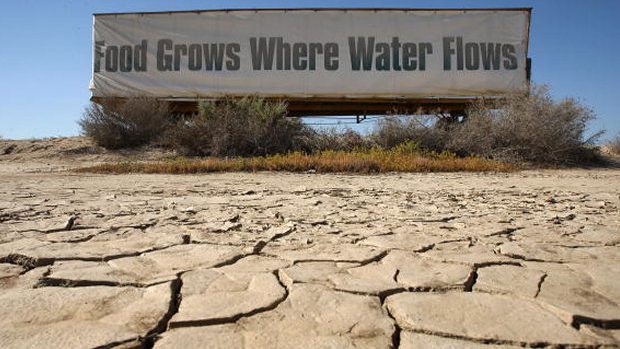 The ongoing drought in California is raising concerns that this year’s fire season could be the worst on record. It’s also pitting farmers against environmentalists over who should be able to use how much of the state’s scarce water supply.
A report by the University of California, Davis’ Center for Watershed Sciences contends that the drought could result in more than 14,000 jobs being lost and the state’s GDP to decline by over $850 million this year, as farmers are forced to leave fields fallow due to the absence of water. Central Valley farmers are demanding the state bypass water usage restrictions that mandate a minimum level of flow to protect fish in the state’s rivers and bays, and divert water to farms for food production instead. Environmentalists assert that the suspending the minimum flow requirements would pose threats to several fish and bird species on the Endangered Species List.
The drought’s impact will not be limited to California. A study by Arizona State University concluded that the entire United States will likely see sharp increases in the price of avocados (projected to increase 28 percent his summer) and lettuce (projected to jump 34 percent). Price increases were also forecast for berries, broccoli, grapes, peppers, and tomatoes, and a wide variety of nuts.
California is responsible for about half the fruits and vegetables grown in the United States. As the short-term methods for coping with the drought are exhausted, food production will likely decline, and food prices will increase.
But even more alarmingly, long-term models suggest that this kind of drought will become increasingly common as climate change continues. It’s a bleak picture for the future of food.
 A study commissioned by the Bill and Melinda Gates Foundation and published by the World Health Organization earlier this week reached some starting public health conclusions. The study found that the proportion of overweight and obese people increased in every country in the world between 1980 and 2013, and that nutrition-related diseases, including diabetes and pancreatic cancer, are also increasing. The report, published in the Lancet yesterday, found that globally, 36.9 percent of men and 38.0 percent of women are now overweight, increases from 28.8 percent of men and 29.8 percent of women in 1980. The study found that the fastest rate of growth in the prevalence of overweight and obesity was in the developing world. And perhaps most alarmingly, the report could not identify a single national success story—a country in which the proportion of overweight and obesity held steady or declined over the study period.
The study’s lead authors, Christopher Murray of the Institute for Health Metrics and Evaluation at the University of Washington, observed that, “It’s pretty grim…When we realized that not a single country has had a significant decline in obesity, that tells you how hard a challenge this is.”
It’s long been noted that economic development tends to be accompanied by a change in diets, as wealthier individuals tend to eat more meat and processed foods high in salt and sugar, and drink more sweetened drinks like soda. Urbanization also results in shifts in the types of work performed by large portions of the population, moving from outdoor physical labor (often on farms), to indoor, sedentary labor (often in offices).
If the trend observed in this week’s study continues, the benefits of economic growth in the global south could be offset by sharp increases in the cost public health necessary to treat diet-related diseases.
The Reinheitsgebot, or the Bavarian Purity Law, dates to 1487 and specified that three ingredients—water, malt, and hops—and only three ingredients could be used to brew beer. While the law was amended in 1993 to permit the use of constituent ingredients like yeast, wheat malt, and cane sugar, the basic formula of water, malt, and hops, remains at the core of brewing, even as the number of brewers around the world has ballooned.
It shouldn’t be surprising, then, that a group of microbrews in the United States has joined forces to draw attention to the problem of clean water. Dubbed “Brewers for Clean Water” and sponsored by the Natural Resources Defense Council, the group works to draw attention to the importance of protecting water supplies. The group also commits to reducing their own water consumption.
 According to a new study at Western Oregon University, 59 percent of students on that campus were food insecure at least once in the previous year, leading researchers to conclude that “food insecurity seems to be a significant issue for college students.” A similar study conducted in 2009 at the University of Hawaii at Manoa concluded that 21 percent of students faced food insecurity. Nationally, the figure for all households is 14.5 percent, leading most observers to conclude that college students face a higher-than-average level of food insecurity in the United States.
The 2014 Farm Bill makes things worse, limiting students’ eligibility for the Supplemental Nutrition Assistance Program (SNAP). Blogging at TakePart, Kristina Bravo noted that “Higher tuition and expenses have forced students to cut back on food, and an increasing number of youths from low-income families are enrolling—higher education has long been championed as the key to social mobility. But an empty stomach can only get you so far, and we don’t need a study to prove that.” She’s absolutely correct.
In an era of high-priced meal plans and higher tuition, the “Freshman 15” is increasinly a thing of the past. The question is, what are we doing about it?
 Global Food Politics